
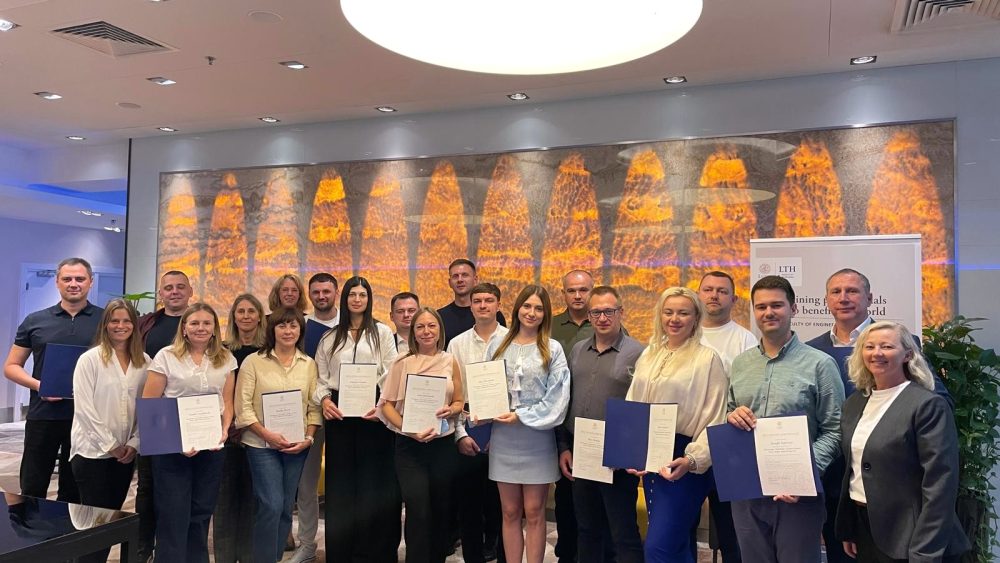
In September, participants in the Swedish Institute-funded capacity development programme ‘Developing a Sustainable Transport System from a Rights-Based Perspective’ met in Warsaw, Poland, for its concluding conference.
The conference brought us back to where we started: looking at transport through a rights-based perspective, with sustainability and Ukraine’s EU integration at the centre. This time, however, the discussions drew on the knowledge, experiences and individual projects developed by participants over the past year.
From ideas to practical action
The 23 participant projects illustrate the many dimensions of transforming Ukraine’s transport sector. They range from solar-powered public transport and renewed railway connections to safer cycling, accessible mobility, digital planning tools and more transparent transport financing.
Rooted in challenges identified within participants’ own organisations and communities, the initiatives span local, regional and national levels. Together, they show how reconstruction can be an opportunity not simply to restore what existed before, but to build transport systems that are safer, greener, more resilient and accessible, while contributing to Ukraine’s alignment with European approaches to sustainable mobility.
Several ideas have already moved into practical action. These include a pilot on solar powered public transport and a digital cycling map, while others have initiated working groups, pilot preparations and new planning processes. Many have also produced concrete strategies, models or investment proposals that can now be taken forward within participants’ organisations.
Space of action and stronger professional networks
One of the most tangible outcomes of the programme is the network that has developed between participants. Working at local, regional and national levels, they have gained a better understanding of each other’s roles, challenges and areas of responsibility and, importantly, know who to turn to when a question requires cooperation across institutional or geographical boundaries.
But the discussions in Warsaw were not only about what institutions, policymakers or partners need to do. They also brought the question back to the participants in the perspective as individuals: What can I do in my professional role today, rather than waiting for the right decision, policy or funding to be in place?
This combination of individual agency and stronger professional networks is perhaps one of the most important outcomes of capacity development: not only knowing more, but having both the connections and the ability to put that knowledge into practice.
Transport as part of Ukraine’s resilience
The importance of transport became particularly tangible around the Warsaw conference. As participants were making their way from Ukraine to Poland, attacks affected Ukraine’s railway infrastructure – an important reminder of just how much depends on transport systems continuing to function.
Without functioning transport and the infrastructure that supports it, mobility quickly becomes about much more than getting from one place to another. Transport enables people to reach healthcare, schools, employment and other essential services, and is therefore closely connected to the ability to exercise fundamental rights. It also keeps communities connected and allows food, medicines and other essential goods to reach where they are needed.
Seen from this perspective, resilient and accessible transport is fundamental both in times of war and for the future. Continuing to develop transport systems that are safe, sustainable and inclusive is part of responding to Ukraine’s needs today, while also contributing to reconstruction and the country’s continued European integration.
An ending – and a starting point
The Ministry for Recovery, Infrastructure and Transport of Ukraine, together with the Faculty of Engineering at Lund University and K2 – the Swedish Knowledge Centre for Collective Mobility, is working towards the establishment of a Ukrainian competence centre for sustainable transport. The ambition is to create a platform connecting research, policy and practice and providing a space for knowledge exchange and collaboration.
The relationships established over the past year – and the programme’s new alumni network – can become an important part of that next chapter.
Read more about the capacity development programme Developing a Sustainable Transport System from a Rights-Based Perspective here and here.
Read more: Moving Forward Together: Sustainable Transport in Ukraine